About Kombucha
A closer look at the living culture, the fermentation process, the traditions and the curiosity behind this fascinating brew.
What is Kombucha?
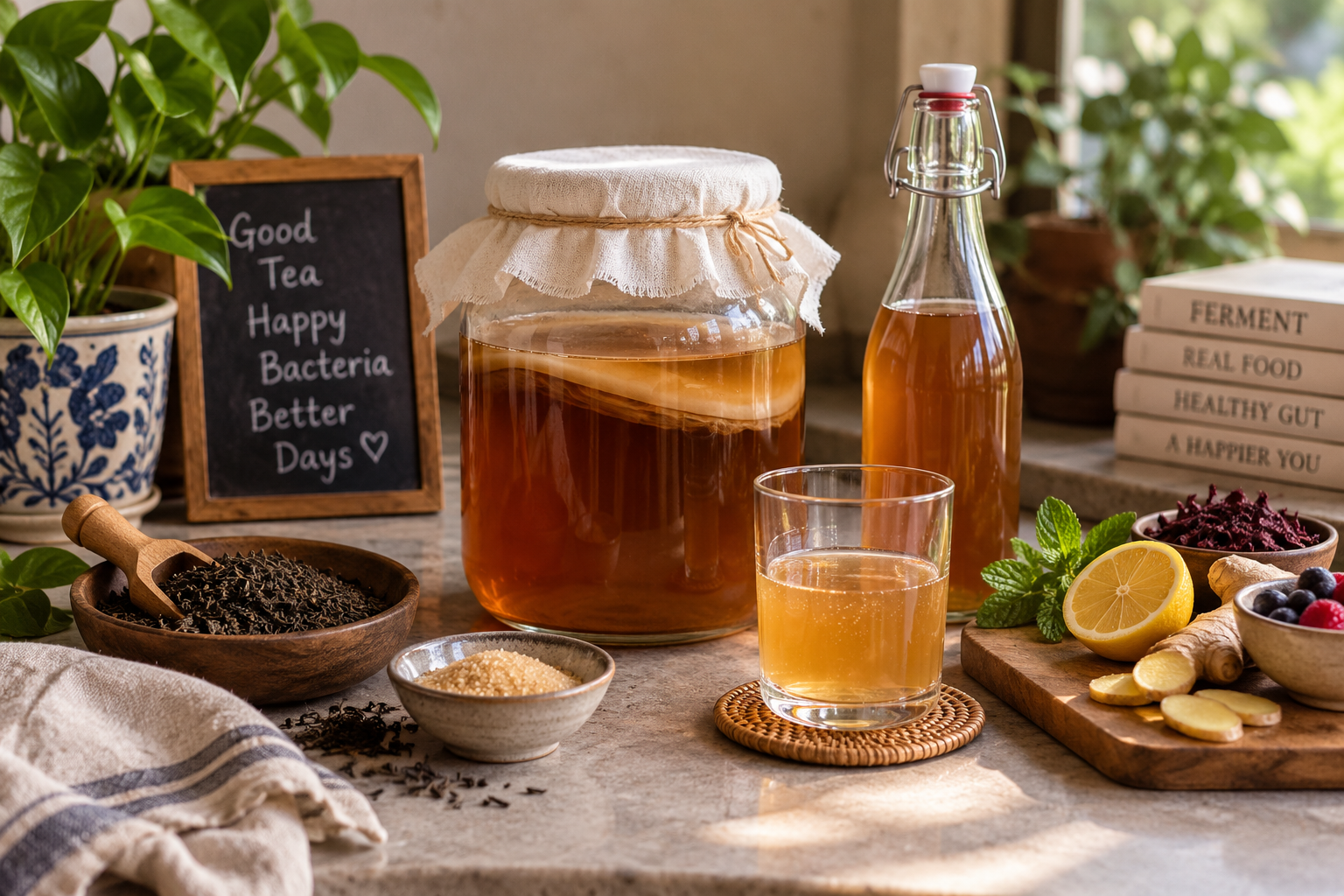
Kombucha is a fermented tea made with tea, sugar and a SCOBY — a living culture of bacteria and yeast.
The sweetened tea is left to ferment with the SCOBY. Over time, the culture transforms the tea, creating the distinctive tartness, aroma and gentle natural fizz that we associate with kombucha.
What begins as a few simple ingredients becomes a living, changing brew.
And that is where the fascination begins.
Why Brew at Home?
Because brewing kombucha yourself lets you experience the process, not just drink the result.
You get to choose your tea, watch the fermentation develop, understand your SCOBY, and learn how small changes can influence the final brew.
And then comes the fun part — you can experiment.
Different teas. Different fermentation times. Different flavours.
Some brews surprise you. Some work beautifully. Some don't quite work at all.
When you brew at home, kombucha becomes something you make, understand and discover for yourself.
Home Brew vs Commercial Kombucha
BUY A BOTTLE — OR BREW A BATCH?
A commercial bottle gives you kombucha that is ready to drink — convenient, consistent and packaged for a longer shelf life.
Home brewing is different.
You start with tea, sugar and a SCOBY, and from one brew you can fill several bottles to enjoy, share and flavour your own way.
Commercial kombucha may also be filtered, carbonated, pasteurised or otherwise processed depending on the brand and product. Home brewing lets you stay much closer to the fermentation process itself.
Ready to drink.
Several bottles. Your tea. Your flavours. Your experiment.
It's not about which is better.
It's about knowing the difference — and discovering what happens when you make it yourself.
A little history
Kombucha has been around for a very long time. Its origins are generally traced to northeastern China, where fermented tea was consumed centuries ago. From there, the tradition travelled through Asia and eventually into Russia and Europe, taking on different names and forms along the way. (source)
There are many stories surrounding its journey — including tales of emperors, travelling physicians and its reputation as a drink associated with health and longevity. Some of these are part of kombucha folklore rather than firmly established history, which makes the story all the more intriguing. (source)
What began as an old tradition is now brewed in kitchens and breweries around the world.
Different places. Different traditions.
The same fascinating idea — tea transformed by fermentation.
Meet the SCOBY
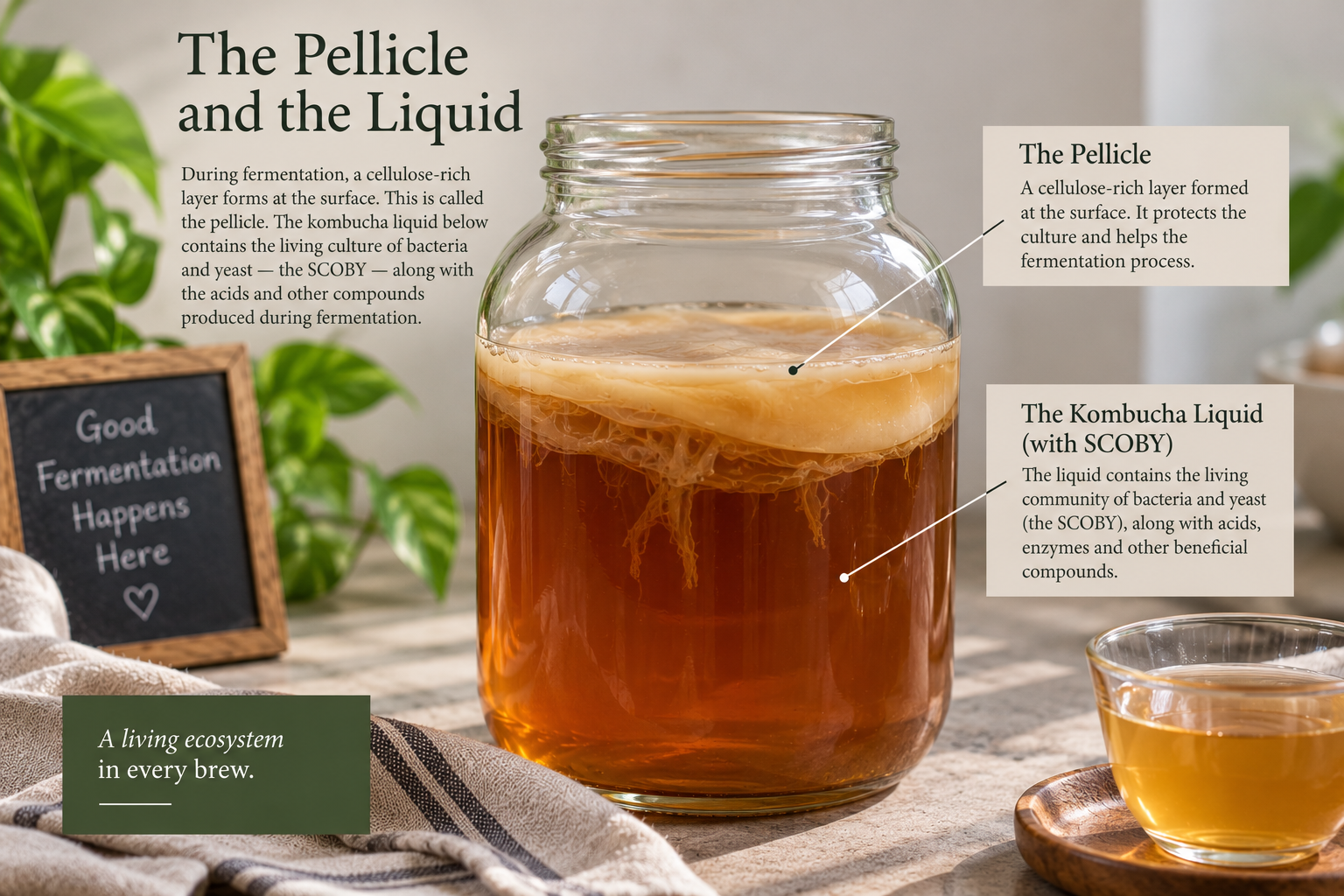
The SCOBY is the living culture of bacteria and yeast that makes kombucha fermentation possible. It is present throughout the brew — not just in the familiar rubbery layer floating on top.
That layer is called the pellicle. It is a cellulose-rich structure produced during fermentation, and it provides a place where some of the microorganisms live and work.
The liquid itself contains the living culture too, along with the acids and other compounds produced during fermentation.
So when you receive a SCOBY for brewing, you are typically working with the pellicle together with some mature kombucha liquid.
A living culture.
A changing brew.
And a rather fascinating little ecosystem.
What Happens During Fermentation?
You begin with sweetened tea and the SCOBY. Then the living culture gets to work.
The yeasts break down sugars, producing alcohol and carbon dioxide. The acetic-acid bacteria use the alcohol and convert it into organic acids, including acetic acid.
As this happens, the brew gradually changes — sweetness decreases, acidity develops, aromas evolve and the flavour becomes more complex.
Temperature has a role too. Kombucha generally ferments well between 20°C and 30°C, with around 25°C being a comfortable range. Too cool and fermentation slows; too warm and it can move faster and become more acidic.
And this is why no two batches are necessarily identical.
Tea. Temperature. Time. Culture.
They all influence what happens inside the jar.
Fermentation is not simply leaving tea to sit.
It is a living process of transformation.
Tea Matters
Kombucha begins with tea — and the tea you choose influences the brew.
Black, green and oolong teas each bring their own character, from flavour and aroma to the compounds available to the culture during fermentation.
That is why changing the tea can change the kombucha.
Same SCOBY.
Different tea.
A different brew.
And this is one of the simplest ways to begin experimenting at home: start by paying attention to the tea.
First Fermentation — F1
This is where the sweetened tea becomes kombucha.
The tea and SCOBY are brought together and left to ferment. Over the course of fermentation, the culture gradually transforms the sweet tea — developing the tang, acidity and character we associate with kombucha.
F1 is the foundation of the brew.
Once you understand what is happening here, you can begin to appreciate how much room there is to experiment with what comes next.
First fermentation.
The foundation of every brew.
Second Fermentation — F2
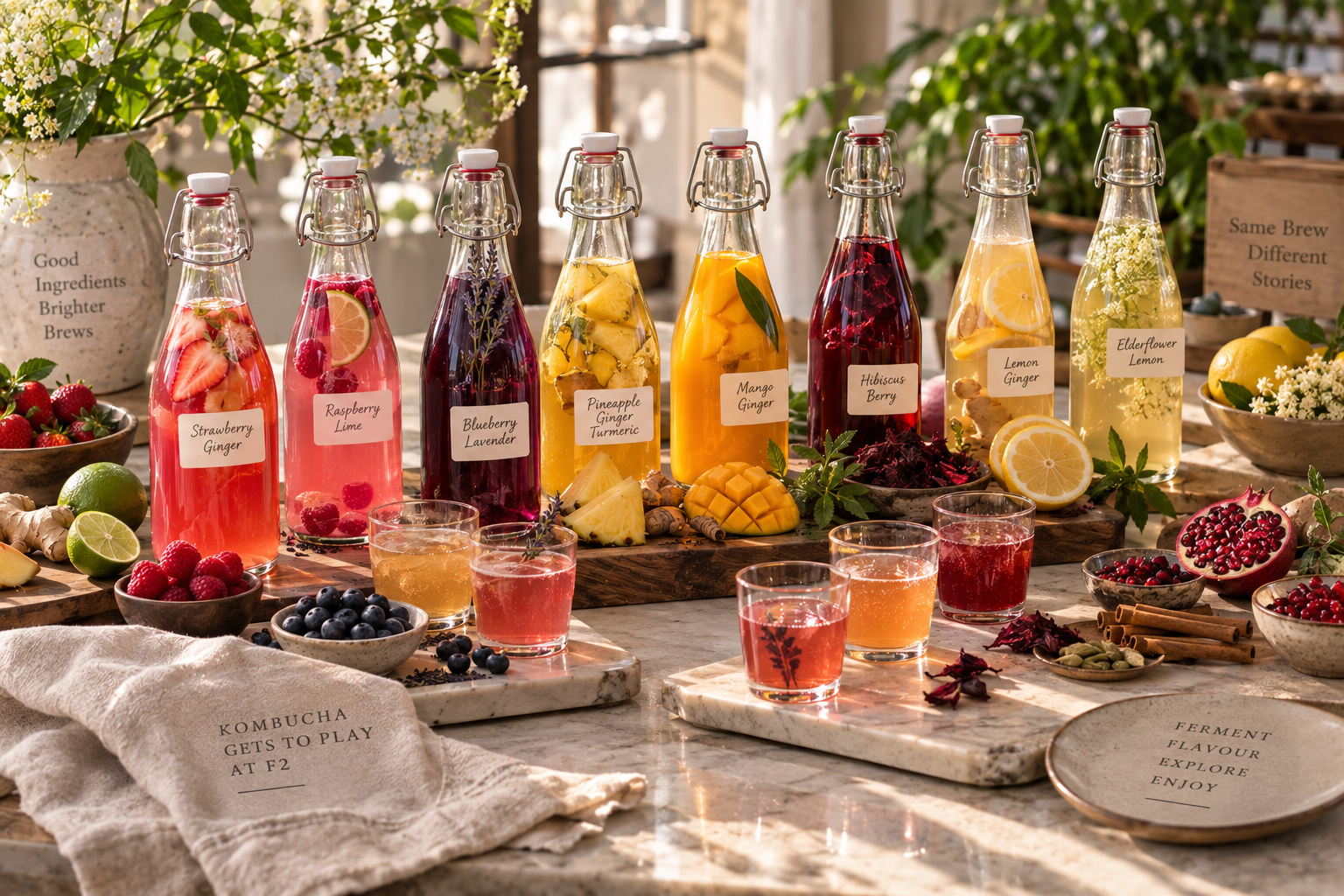
This is where kombucha gets to play with flavour.
Once the first fermentation is ready, the kombucha can be introduced to fruits, spices, herbs or floral ingredients and left to ferment again.
This second stage can bring new flavours, aromas and natural carbonation to the brew.
And unlike F1, where the process is largely about building the kombucha, F2 gives you much more room to experiment.
A little fruit.
A touch of spice.
Something floral.
One kombucha. Endless possibilities.
At The Kombucha Table, this is where you get to create your own flavour combination and discover what happens next.
Why Add Flavour?
F1 gives kombucha its foundation.
F2 lets you build on it.
Fresh fruits, herbs, spices and floral ingredients bring new flavours, aromas and colours — and they also introduce their own natural nutrients and plant compounds into the brew.
Fruit can bring vitamins and polyphenols.
Spices and herbs bring their own distinctive plant compounds.
Floral ingredients add aroma and colour.
And during F2, the living culture continues to interact with the sugars and compounds from these ingredients.
So F2 isn't just about making kombucha taste different.
It's about discovering how much more a simple brew can become.
Kombucha — an “elixir of life”?
Kombucha has been described as an “elixir of life” for centuries and has traditionally been associated with health and longevity.
The fermented drink contains tea polyphenols, organic acids, vitamins and other bioactive compounds. Research has reported antioxidant and antimicrobial activity, and scientists are studying its possible effects on the gut microbiome, blood glucose and other metabolic markers. (source)
Human research is now beginning to explore some of these effects. Studies have reported findings including changes in the gut microbiome and, in one small controlled trial, a reduction in fasting blood glucose in adults with type 2 diabetes. (source)
So the interest in kombucha isn't without scientific basis.
At the same time, the human evidence is still developing, with studies varying in size, duration and design. Research continues to examine which effects are reproducible and how they relate to the compounds produced during fermentation. (source)
There is a fascinating body of research here — and much more still to discover.
Want to read a little deeper?
Kombucha research is evolving, and there is some fascinating reading available for anyone curious to look beyond the usual health claims.
- Kombucha — An Ancient Fermented Beverage with Desired Bioactivities: A Review
- Kombucha Beverages Produced from Fruits, Vegetables, and Plants — Health Benefits Review
- Kombucha and the Human Gut Microbiome — Controlled Clinical Study
- Kombucha and Blood Glucose — Randomized Controlled Pilot Study
Have a read. Follow the evidence. And make up your own mind.
The Kombucha Table Philosophy
At The Kombucha Table, we believe kombucha is more than a drink.
It is something to understand, make, taste and explore.
We share what we know, stay curious about what we don't, and encourage you to develop an understanding of the process rather than simply follow a recipe.
Because once you understand what is happening in the jar, you can begin to make it your own.